
Now that the Gate City Pen and Ink Company’s new Belmont Pen is in production, I think it would be cool to show you what happens in the development of a pen.
The first thing is the concept. Even before we had really begun to get a sense of how well (or poorly) the New Postal Junior was going to do, planning had started on our second pen. The design parameters were simple:
-
1.The new pen would be more modern than the New Postal, but it would still have that vintage feel.
-
2.It would come in only one size.
-
3.It would use another simple and reliable — and unusual — filling system.
Okay, which filler should get the nod? Well, as it happens, one of my all-time favorite filling systems is this one:


What you’re looking at, of course, is a pen with a syringe filler — in this case, a Du-Pont. I fell in love with the syringe filler when I met my first Morrison Patriot. The Patriot hides its filler inside a removable barrel, making it almost like a modern Parker syringe-style converter, but it’s really an integral syringe filler:


And syringe fillers are cool in more ways than just the fact that I like them: there’s a minimum of parts, and superb performance because the filling system give you the fastest, most positive flush and fill of any system ever made. So the choice of filler was pretty well settled; the only potential hitch was whether Bexley, Gate City’s manufacturing subcontractor, could make a syringe filler. I put the question to Howard Levy, president of Bexley, and sent him a copy of this sketch showing how I thought a piston might be made by turning it from a length of acrylic rod and fitting it with two O-rings:
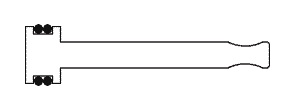
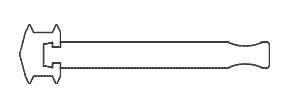
Howard didn’t like that sketch; there were manufacturing issues that would make it not such a good design. So he did a little headscratching, and he came up with a source for the rubber seal that goes into an ordinary medical syringe! This little goodie just snaps over a bulb-like protrusion on the end of the plunger shaft, exactly the way the seal in a modern Pelikan piston filler attaches. It yields a design that’s easy to make, very inexpensive, and super reliable because the precision dimensions of the sealing mechanism are left to the seal itself rather than to the machining of the piston.
The next question was the styling of the pen. Based on when the syringe filler was most prevalent — during World War II, when it could be made with no critical war resources (specifically, rubber) — I was looking at 1940s designs like that of the Do-Pont pen shown above. But I wanted a thicker pen, one that would fit the hand for long-term writing comfort. Then I remembered one of the cooler pens I know, the second-generation predecessor to Wahl-Eversharp’s fabulous Equi-Poised:

Here was a design I could love, and never mind that it was from about 1930. With its tapered ends and its slightly keg-shaped barrel, it would work beautifully and look good. We could even use the same roller clip that features on the New Postal Pen.
No, scratch the roller clip. That’s the 1920s. Wahl-Eversharp used a faceted Art Deco version of it on the first-generation Doric, but by the middle of the 1930s it was gone in favor of a smoother rollerless design:

As it happens, Bexley also uses a clip like this on some of its pens:

The Bexley clip would be perfect but for one tiny thing: It has a B on the facet at the shoulder. How would we deal with — oh, of course! Give the pen a name beginning with B! And what better name than Belmont? Back in the day, Belmont was a house brand for the Rexall Drug chain. Belmont pens were solid and well made, certainly not an embarrassment should someone connect the dots. Belmont is the name of a Massachusetts town, and some of Rexall’s pens were made in Massachusetts — which origin could actually be the source of the pen’s name.
So, with a name in hand, I made a sketch and sent it to Howard along with the photo of the Wahl-Eversharp pen.
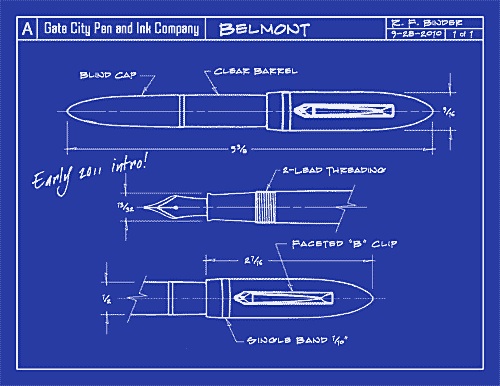
The sketch shows completely rounded ends like those on a Sheaffer Balance, but I explained that what I wanted was a flattened cone like that on the Wahl. What came back was two prototypes. This is one of them:


The other is identical to it except for the color of the cap and the blind cap.
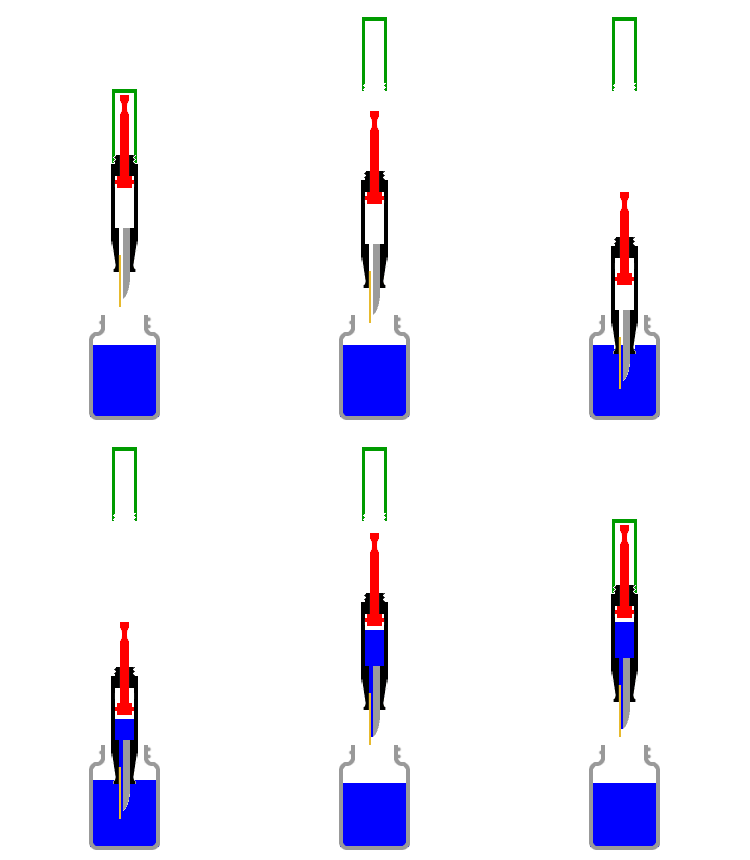
The first concern was the filler. How well does it work? Howard had been hauling a third proto around in his pocket for about a week when ours arrived, so the odds seemed to be in favor of its not leaking. And filling, man, it couldn’t get any better. Push, pull, clean, and you’re done:
And the pen wrote and handled well. Once the operation was settled, it was time for final styling tweaks. So what got tweaked?
-
1.The shape of the prototypes’ section was the same as that of the New Postal Pen, only adjusted for diameter. It’s a good shape, but it was too old fashioned. I wanted something sharper, more cleanly modern. I found that shape here:

-
2.The tapered portion of the cap, above the clip, was a bit clunky. I wanted a longer taper, and for that I went back to the Wahl-Eversharp pre-Equi-Poised model shown above.
-
3.The barrel looked a little bit like two long conical shapes shoved together. It need to be a little less cramped as it descended from the width at the joint to the width near the threads. For this I looked to the distinct keg shape of Columbia, the Gem of the Ocean, which I designed in 2003 for Filcao of Italy.

I consulted with Howard on what I wanted, and — as he always does — he produced the perfect edit job. When the production pens arrived, I was (and still am) thrilled with them.


The Belmont is a pen that has distinct 1930-ish touches, but its overall sensibility, I think, is 1940-ish, which is what I was aiming at.
And that, Gentle Reader, is how an idea ends up in somebody’s pocket instead of in the trash can.